Materials Discovery
Explore proposed compositions and structures against high-temperature aerospace requirements.
MATERIALS DISCOVERY + ENGINEERING INTELLIGENCE
Obelisk is an AI-assisted materials discovery and engineering intelligence platform focused on high-temperature aerospace. Explore candidate materials and connect chemistry, structure, synthesis, processing, and degradation risks in one technical workflow.
Proposed candidates. Inspectable reasoning. Laboratory validation still required.
CAPABILITIES / SEVEN CONNECTED DISCIPLINES
From candidate discovery to engineering decisions. Explore how a material could be made, where it could fail, and what to investigate next.
Explore proposed compositions and structures against high-temperature aerospace requirements.
Examine synthesis routes, processing constraints, and heat-treatment strategies.
Investigate creep, oxidation, fatigue, and potential failure mechanisms.
Identify relevant calculations, characterization methods, and laboratory tests. Planning supports testing; it does not replace it.
Propose lower-toxicity alternatives or changes for a demanding application, while exposing new tradeoffs. Redesign is not a safety certification.
Compare performance, manufacturability, cost, and risk to prioritize promising directions.
Inspect available atomic coordinates and clearly labeled structural models through interactive visuals. Conceptual models are distinguished from validated structures.
“Propose a lower-toxicity version of this candidate. Explain what changes, what performance could be lost, and what needs testing.”
01 / THE BOTTLENECK
High-temperature aerospace development requires costly synthesis, heat treatment, microscopy, mechanical testing, and long-duration exposure studies. Teams must connect these experiments with scattered literature, simulation results, and processing knowledge. Investigating an unsuitable candidate can consume valuable equipment time and budget.
Obelisk brings those decisions into one reviewable workflow: explore candidates, surface potential failure mechanisms, compare manufacturing options, and prioritize what deserves further calculation or laboratory testing.
Separate data sources → manual reconciliation → repeated screening → costly experimental iterations
Analysis depth depends on available data and configured tools. Proposed candidates still require validation.
02 / METHODOLOGY
Obelisk is designed to preserve the connection between what a material must do, how it could be made, why it could fail, and what must be tested next.
Temperature, stress, atmosphere, lifecycle, cost, and processing limits become explicit constraints.
Proposed compositions and structures enter a controlled candidate workspace.
Chemistry, geometry, toxicity, and obvious stability conflicts are surfaced early.
Processing, phase stability, creep, oxidation, fatigue, and degradation are examined together.
Performance, manufacturability, confidence, and risk are compared without hiding conflicts.
Assumptions, evidence, uncertainty, and required validation tests become one engineering record.
03 / TECHNICAL OUTPUT
A result is useful only when the composition, structural model, manufacturing context, failure mechanisms, and validation requirements remain inspectable.
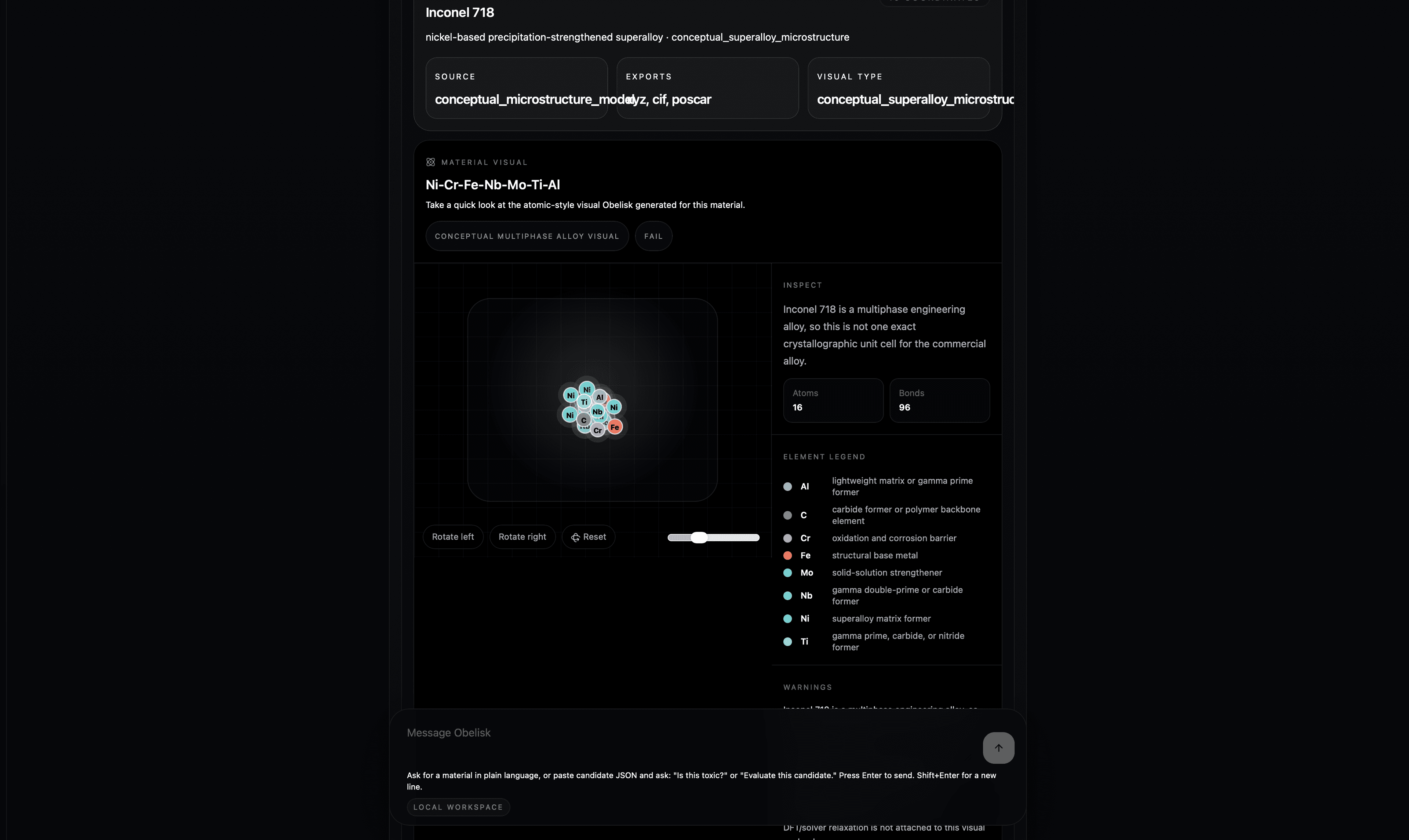
Real interface capture. Conceptual structure shown; not presented as a solver-relaxed commercial alloy unit cell.
04 / INITIAL FOCUS
Obelisk is narrowing its first operating domain to materials where temperature, time, atmosphere, processing, and microstructure interact under severe constraints.
Known-material agreement demonstrates workflow behavior. It does not establish universal predictive accuracy or replace qualified engineering review and physical testing.
06 / SCIENTIFIC INTEGRITY
Each technical claim should retain its origin, confidence, limitations, and next validation action. The platform is built to expose uncertainty, not decorate it.
Selected case studies, methodology, limitations, and demonstration requests.
The scientific engine, customer workspaces, candidate data, and internal logic remain private.
Protected project information requires a separate agreement and controlled workspace.
FREE GUIDED EVALUATION / OPERATOR-RUN
We operate Obelisk for your team and deliver the results. No installation or hosted app access required.
Research assistance, not certified engineering conclusions or guaranteed discoveries. Physical testing and heavy simulations are excluded unless separately agreed. No payment is required for the agreed evaluation. Continuing afterward is optional and requires a separate paid agreement.
TECHNICAL Q&A / MATERIALS INTELLIGENCE
What Obelisk does, how it helps, and what your team receives.
Discuss your materials questionEmail us for a free evaluation, technical questions, or collaboration. Please keep your first message non-confidential.
Obelisk examines possible ways to make a material and explains why a route might fit. For an alloy, it can compare melting, forging, and heat treatment, then point out processing risks.
Obelisk looks at what each element contributes and how the elements work together. For example, it can explain why a change might improve heat resistance but make an alloy harder to manufacture.
You provide the properties and constraints you need, and Obelisk proposes compositions and structural models to investigate. Where coordinates are available, you can inspect the atomic arrangement; illustrative models are labeled separately from measured or calculated structures.
Obelisk checks for obvious problems, such as atoms placed too close together or a composition that does not fit the proposed material. These checks help reject bad inputs, but do not prove that a structure will be stable.
You describe where and how the material will be used, and Obelisk examines what could go wrong. For example, a hot turbine environment may call for checking slow deformation under load, oxidation, and damage from repeated heating and cooling.
Obelisk compares candidates against your requirements, such as heat resistance, cost, and ease of manufacturing. It explains where each candidate performs better and what you would give up by choosing it.
You can ask for a change, such as reducing toxicity or making a candidate easier to manufacture. Obelisk proposes alternatives and explains how those changes could affect performance.
Obelisk separates methods supported by references from routes it proposes for investigation. It also distinguishes how the material was made, so a property reported for a forged part is not automatically treated as valid for a 3D-printed one.
Obelisk suggests checks that address the question you are asking, such as strength testing, imaging, or oxidation testing. It distinguishes a recommended test from a completed calculation; not every answer uses DFT.
Obelisk organizes the analysis into a technical report you can review and share. It brings together material comparisons, manufacturing options, risks, available sources, assumptions, and suggested next tests.
You can ask about the same material without starting the explanation over. For example, after discussing heat resistance, you can ask how changing the manufacturing route might affect it; during the evaluation, we confirm the candidate and conditions being discussed.
The free evaluation lasts two weeks and covers up to three agreed, non-confidential aerospace materials questions. We run Obelisk for you and deliver reports, one walkthrough, and one revision; it does not include direct app access, physical testing, or heavy simulations unless separately agreed.
The two-week guided evaluation is free within the agreed scope. If you want to continue, we discuss your requirements and agree on pricing privately before starting paid work. There are no automatic charges or renewals.
07 / CONTROLLED ACCESS
Request a free, two-week guided evaluation, or join the free waitlist for future availability.
A waitlist signup is an expression of interest, not a purchase or immediate engine access. Select your request type in the form.
Requests are reviewed manually.
02We contact you to agree on scope and availability. No automatic paid renewal.
03Do not submit proprietary material data.